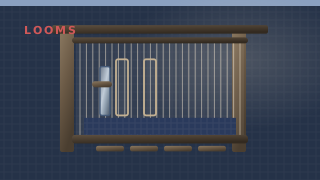
The loom question is really two questions wearing a coat: how wide do you want to weave, and how much pattern do you want? Answer those honestly and the choice is usually obvious. Answer them aspirationally and you will buy a sixteen-shaft loom and weave plain-weave scarves on it.
The three families
| Rigid heddle | Table loom | Floor loom | |
|---|---|---|---|
| Width | 25–80 cm | 25–60 cm | 60–160 cm |
| Pattern | Plain weave + pick-up | 4–8 shafts | 4–16 shafts |
| Shed by | Lifting the heddle | Hand levers | Foot treadles |
| Speed | Fast to set up, slow to weave | Slow to weave | Fastest |
| Portability | High | Moderate | Low |
| Best for | First loom, scarves, towels | Sampling, learning drafts | Wide cloth, production |
A rigid-heddle loom is the fastest route to finished cloth. One heddle gives you two sheds and therefore plain weave, and the sett is decided for you by the dent of the heddle. That constraint is a feature: there is nothing to get wrong, and you can be weaving within an hour of unboxing.
A table loom adds shafts. Now you thread heddles individually and lift shafts with levers, which means one hand leaves the shuttle for every pick. It is roughly half the speed of a floor loom, but it is quiet, small, and it teaches the draft properly because you feel each shaft lift.
A floor loom ties the shafts to treadles so both hands stay free. It is the only family that is comfortable for a full day’s weaving and the only one that handles genuinely wide cloth. It is also heavy, expensive and it will take two of you an afternoon to assemble.
The two specifications that matter most
Ignore the marketing and look at two numbers. The first is weaving width: a 60 cm loom cannot weave a 70 cm shawl, and weaving a 40 cm piece on a 160 cm loom wastes half your warp in the reed. Choose the width for the cloth you will actually make, not the widest cloth you can imagine making.
The second is shaft count. Four shafts will weave plain weave, twill, herringbone, huck, overshot and more than you can exhaust in several years. Eight shafts opens up satin, damask and complex lace. Sixteen is a specialist tool. If you are unsure, buy four and buy good.
Buy a used loom from someone who wove on it
A second-hand loom that comes with its previous owner’s warps, reeds and heddles is usually better value than a new one, and you get an afternoon of instruction with it. Check the brake holds, the beater is square and the reed is not rusty.
What nobody tells you about floor space
A floor loom needs about 1.2 m by 1.0 m of clear floor, plus room to walk round the back to wind and to reach the front to inspect. It also needs to be somewhere you can leave a warp on it for a month — a loom that has to be folded away every evening will be used a fraction as often as one that does not.
Before you buy
Measure the doorway, the stairwell and the corner you intend to put it in. A 160 cm floor loom arrives as a bundle of beams, but the assembled width is the number that matters, and it is the number people forget.
The honest recommendation: if you have never woven, buy a rigid-heddle loom, weave ten things, and then decide. It is the cheapest way to find out what you actually like making.