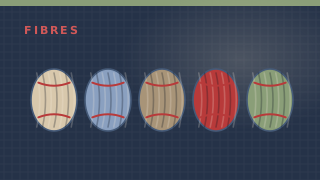
Fibres differ in a hundred small ways, but for a weaver one property dominates: elasticity, the amount a fibre stretches before it breaks. Everything about how a yarn behaves on the loom follows from it.
Elasticity first
Wool stretches by 25–35 % before breaking, and it springs back. That means a wool warp absorbs an uneven beat, recovers from a moment of slack tension, and still produces an even cloth. Linen stretches by 2–4 % and does not recover: every irregularity in your beat goes straight into the cloth.
This is why wool is the best first warp and linen is the worst. It is not that linen is a bad fibre — it is one of the most beautiful there is — but it will not hide anything from you.
| Fibre | Elasticity | Strength wet | Sett (plain) | Shrinkage |
|---|---|---|---|---|
| Wool | High (25–35 %) | Lower | 8–12 EPI | 10–25 % |
| Cotton | Low (5–8 %) | Higher | 12–16 EPI | 5–10 % |
| Linen | Very low (2–4 %) | Higher | 10–14 EPI | 8–15 % |
| Silk | Moderate (15–20 %) | Slightly lower | 20–30 EPI | 3–6 % |
| Alpaca | Low (10–15 %) | Moderate | 8–12 EPI | 5–12 % |
Wool
Wool has crimp — the natural wave in the fibre — and the scales on its surface let it felt and full. On the loom that crimp is a shock absorber. After weaving, a fulled wool cloth is dense, windproof and warm, because the fibres have migrated into each other and locked.
Weave a wool cloth with the shrinkage planned in. A fulled coating can lose a fifth of its width and length, and finding that out after you have cut the piece off is expensive.
Cotton
Cotton is strong, inelastic and predictable, and it gets stronger when wet. It takes dye in clear, bright shades and it survives hard washing, which makes it the right fibre for anything that will be used rather than admired: towels, aprons, table linen, bags.
The price of predictability is honesty. Because cotton does not stretch, it does not forgive. Tension it firmly and keep it firm, and accept that your beat will be visible in the cloth.
Linen
Linen is flax, and flax fibre is long — up to 60 cm — which is why linen yarn is smooth, strong and lustrous. On the loom it is stiff and wiry, with slubs and thick places that are part of the fibre rather than a defect.
Linen is transformed by washing. The first wash softens it, the second makes it supple, and by the third it has the cool, dry handle that nothing else has. Wet-finish linen aggressively and do not judge it on the loom.
Silk
Silk is a continuous filament rather than a staple fibre, and its triangular cross-section reflects light, which is where the sheen comes from. It is the strongest natural fibre for its weight, it drapes superbly, and it takes dye more brilliantly than anything else in the dye pot.
It is also the most expensive yarn most of us will use, and the most demanding: fine, slippery and easily abraded by a rough heddle or a rusty reed. Use smooth tools and a tighter sett than the count alone suggests.
Blends behave in between
A 50/50 wool-linen yarn has some of wool’s forgiveness and some of linen’s body. Blends are a good way to get a fibre you like into a warp it would not normally survive.
Choosing for a project
- A first warp: wool. Anything wool, at 8/2 or 8/1 Nm.
- Something that will be washed weekly: cotton, at a firm sett.
- Something to show off a weave structure: linen or silk, where the lustre catches the pattern.
- Something warm and draping: alpaca as weft over a wool warp.
- Something to dye yourself: wool or silk for protein dyes, cotton or linen with a mordant for cellulose.
Sample in the fibre you intend to use. A twill that is beautiful in wool can be limp and lifeless in cotton at the same sett, because the two fibres are not the same material at all.