Weaving has an unusually steep first hour and then flattens out completely. Almost everyone who gives up does so during the warping, not during the weaving — so the trick is to plan a first project that gets you to the shuttle as quickly as possible, with as few opportunities to lose your place as possible.
What you actually need
You need far less than the shops suggest. A rigid-heddle loom, one heddle, one shuttle, a warping peg, a couple of skeins of smooth worsted wool and a pair of scissors will produce a scarf this week. Everything else can wait until you know what you want to make.
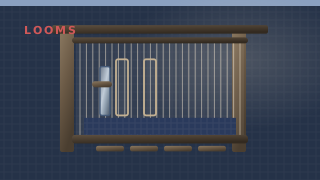
- A rigid-heddle loom around 40–50 cm wide. It warps quickly, has no threading to get wrong, and still teaches you shed, beat and selvedge.
- One heddle in a dent that suits your yarn. A 7.5 or 10 dent heddle covers most beginner yarns.
- A stick shuttle or a small boat shuttle and two bobbins.
- A warping peg and a clamp, or a friend holding the other end.
- Smooth worsted wool in a mid count — 8/2 or 8/1 Nm. Wool is the most forgiving fibre there is.
Skip these at first
A floor loom, a multi-shaft table loom, fine silk, novelty yarn, a second heddle and any pattern more complicated than plain weave. Each one adds a failure mode before you have learned what normal feels like.
Your first warp
Plan a scarf 25 cm wide and 180 cm long in plain weave. That is a real, wearable object, it takes an evening to warp, and it is long enough that you will actually improve while you weave it.
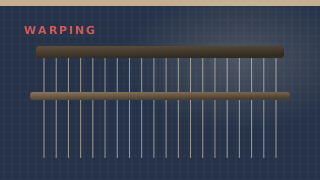
Measure the warp
Two and a half metres of warp gives you a 1.8 m scarf plus loom waste. Wind it on a board or directly on the loom with a peg.
Thread and sley
Alternate ends through slots and holes. Count as you go — an odd end here is a threading error you will only find at the far end.
Tie on with even tension
Tie in small groups, then adjust until every group sounds the same when you pluck it.
Weave a header
Ten picks of scrap yarn to establish the spacing, then start the real weft.
Weave to the end
Throw, beat, change shed. Keep the beat even rather than hard.
The three things beginners get wrong
The selvedges pull in because the weft is pulled too tight at the turn; leave the weft at a shallow angle and beat it in without tugging. The beat is uneven because the weaver speeds up; count out loud or tap a rhythm. And the tension drifts because nobody advances the warp until the shed will not open — advance every few centimetres.
Use the sett calculator
Before you wind anything, put your yarn count and fibre into the Sett Calculator. It returns a starting sett and the reed you need, which saves the single most common beginner disappointment: a cloth that is sleazy or boardy.
What to do with the first piece
Finish it properly: zigzag or overlock the cut ends, wash it gently in warm water with a little soap, and dry it flat. Wash it again. Wool blooms and the cloth closes up, and the piece you take off the loom will look noticeably better after two washes. Then cut a square off the end and put it in a notebook with the sett, the yarn and what you thought of it.
That notebook is the beginning of the part of weaving that is actually yours. The second scarf will be better, the tenth will be good, and the notebook is why.