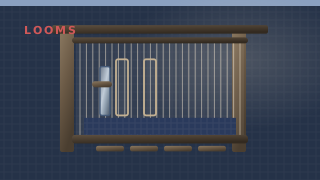
A weaving studio does not need much room, but it needs the right room. The loom is the least of it — what makes a studio work is that you can leave a warp on the loom, see what you are doing, and reach your yarn without standing up.
Start with the loom position
Everything else arranges itself around this. You need clear floor in front of the loom, walking room behind it to wind a warp and to reach the back beam, and enough space on one side to lay out a warping board or clamp a peg.
Put the loom where the light comes from the side rather than from directly in front. A window behind the loom puts you in your own shadow; a window in front shines into your eyes. Side light shows the shed and the weave structure best.
- Clear floor: about 1.5 m in front and 1 m behind a floor loom.
- Side lighting, ideally daylight, with a task lamp you can angle over the warp.
- A power point nearby for the task lamp and, later, a bobbin winder.
- A wall for a warping board — it should be mounted at about chest height on a stud.
- Away from where people walk through, because a tensioned warp and a passing hip do not mix.
Storage that actually works
Weaving generates small objects: bobbins, pegs, heddles, reeds, shuttles, lease sticks, samples. Loose small objects in a studio are a trip hazard and they get lost. A shallow drawer unit with dividers solves most of it.
Reeds need to be stored flat and dry, because rust in the dents will fray every warp you thread through them. Heddles need to stay counted and dry. Yarn wants to be visible — if you cannot see it, you will not use it — but out of direct sunlight, which fades dyed yarn.
The sample notebook has a home too
Keep your swatches, drafts and notes in one binder that lives with the loom. It is the highest-value object in the studio and the one most often scattered across three rooms.
Fibre storage and pests
Wool and silk are protein fibres and moths eat them. Clean cloth is not safe — moths are attracted to the fibre, not to the dirt. Store protein yarn in sealed containers, shake and air it periodically, and check anything you have not touched for a season.
Keep yarn off the floor. Damp floors wick moisture into yarn, and a damp wool cone will felt at the edges before you notice.
A budget that makes sense
Spend first on the loom and the reed, because those set what you can weave. Spend second on a comfortable adjustable chair, because that decides whether you keep weaving. Everything else — bobbins, shuttles, pegs, boards — can be bought used, made from offcuts, or improvised for years.
| Priority | Item | Why |
|---|---|---|
| First | Loom with a clean reed | Sets width, sett and pattern |
| Second | Adjustable chair with back support | Decides whether you keep weaving |
| Third | Warping board or pegs | Makes warping repeatable |
| Fourth | Two shuttles and six bobbins | Lets you change colour without stopping |
| Fifth | Task lamp | Shows the shed and the structure |
| Later | Bobbin winder, fringe twister, extra reeds | Convenience, once you know your habits |
The studio that gets used
The single best predictor of whether a home studio gets used is whether the loom can be left warped. A loom that must be folded away every evening will be woven on perhaps a tenth as often as one that does not. If you have to choose between a bigger loom and a loom that can stay out, choose the loom that stays out.