Weaving looks like the safest craft there is: no heat, no blades spinning, no heavy machinery. That is why the injuries surprise people. They come from stored tension, from sharp small tools, from fibre dust and, most of all, from sitting badly for four hours at a time.
The short version
Tie back hair. Remove rings and bracelets. Lock the brake before reaching into the shed. Never cut a tensioned warp. Mask up when winding dusty fibre. Ventilate when dyeing. Take a break every forty minutes.
The loom itself
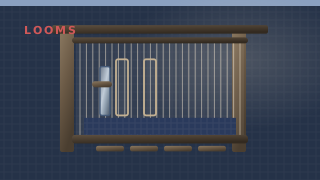
A floor loom stores energy in the warp, the springs and the beater. The shed is a gap that your fingers will want to explore, and it can close on them when you release a treadle or when a tie slips. The rule is simple: lock the tension before you put your hands anywhere near the heddles, the reed or the shed.
- Lock the brake and release the treadles before threading, sleying or clearing a tangle.
- Keep fingers out of the reed race while the beater can move.
- Never cut a warp under tension — release it first.
- Check the brake holds overnight before leaving a warp on the loom.
- Tie back long hair and remove rings, bracelets and loose sleeves; the beater and shafts will catch them.
- Move and assemble a floor loom with two people. They are heavier than they look and the frames are awkward.
Sharp tools and small parts
A heddle hook is a fine steel point that you draw toward your own hand hundreds of times an hour. Point it away from your other hand and never toward your face. Fringe twisters have sharp hooks under tension. Warp ends flick back when a knot slips, and a wet linen warp end can cut.
Keep small parts — bobbins, pegs, heddles — in a tray rather than loose on the floor. A bobbin under the treadles is a trip hazard and can jam the loom mid-pick.
Fibre dust
Winding, tearing and brushing fibre puts fine dust into the air, and cotton, flax and wool dust are all respiratory irritants. Some people develop sensitivity over months of exposure, which is why the answer is ventilation and a mask rather than willpower.
- Ventilate the room while winding and while handling raw fibre.
- Wear a dust mask for large quantities or for very fine fibres.
- Never dry-sweep a studio — use a vacuum with a fine filter, or a damp cloth.
- Clean the loom after weaving fluffy yarns such as chenille and bouclé.
Dyeing and mordants
This is the part of weaving that can genuinely harm you. Mordants are metal salts; some, such as tin and chrome, are seriously toxic. Indigo vats are strongly alkaline and can cause serious eye damage. The rules are not negotiable.
Dye area rules
A dedicated pot that never touches food. Gloves, goggles and a mask when weighing powders. No eating or drinking in the area. Everything labelled and locked away from children and animals. Never mix chemicals casually, and never add anything to a hot alkaline bath. Dispose of spent baths according to your local regulations — never into stormwater.
Ergonomics: the injury nobody notices
The most common weaving injury is not an accident at all. It is a repetitive strain injury from hours at a loom that is the wrong height, with a stool that has no back support and a beater that is just slightly too heavy.
Set the loom so your forearms are roughly parallel to the floor at rest and your elbows clear the beater. Sit with your feet flat and your knees at about ninety degrees. Keep the warp at a height where you are not reaching down or up.
- Stand up and move every forty minutes, even if the pattern is going well.
- Stretch your wrists and forearms before and after a session.
- Keep the working area lit properly — eye strain shows up as a stiff neck.
- If your shoulders ache, the loom is too high; if your back aches, the stool is wrong.
- Alternate long weaving sessions with other work rather than doing six hours in one go.
The best safety equipment in a weaving studio is a loom set up correctly, a chair you can sit in for an hour, and the habit of stopping.