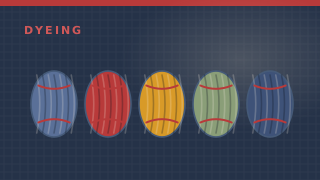
Natural dyeing has a reputation for being soft, pale and unpredictable. That reputation comes from doing it without mordants and without temperature control. Done properly, madder gives a red as deep as any synthetic and cochineal gives a magenta nothing else matches.
Read this before you buy anything
Dye chemicals and mordants are not food. Use a dedicated pot that will never be used for cooking, keep everything labelled and locked away from children and animals, wear gloves, goggles and a mask when weighing powders, and dispose of spent baths according to your local regulations — never into stormwater.
The mordant comes first
A mordant is a metal salt that bonds the dye to the fibre. Without one, most natural dyes rinse straight out. Alum is the safe default: it gives clear, bright, colour-true results and it is forgiving of small mistakes. Iron saddens a colour towards grey or black and is very strong — 1 % of the fibre weight is usually plenty. Copper deepens greens and blues. Tin brightens but makes the fibre brittle.
Mordant before dyeing (pre-mordant), at 60–80 °C for about an hour, then let the fibre cool in the bath. Cooling slowly lets the metal bond evenly; pulling the fibre out hot gives a blotchy result.
Indigo: the dye that is not like the others
Indigo is insoluble in water. To dye with it you have to chemically reduce it into a yellow-green soluble form — the vat — dip the fibre, and then let the air oxidise it back to blue. The colour appears after the fibre leaves the pot, which is disconcerting the first time and delightful every time after.
A healthy vat looks like a dark mirror with a coppery skin on the surface. If it looks blue and cloudy, it has oxidised and needs more reducing agent. Colour builds in layers: six short dips give a better, deeper blue than two long ones, and the shade moves from pale sky towards near-black as you go.
Never stir the sediment
The sludge at the bottom of an indigo vat holds unreduced dye. Disturb it and the pigment deposits on the fibre as crocking — a blue that rubs off on everything it touches. Dip gently, straight in and straight out.
Madder: the red that punishes haste
Madder root gives the warm brick red of traditional rugs. It is an anthraquinone dye that needs an acidic bath and a slow temperature ramp: add the fibre at 40 °C and raise the temperature gradually to 60–80 °C. Take it up too fast and the red goes brown and dull, permanently.
Iron in the water or the pot shifts madder towards purple, and hard water dulls it. Use a dedicated stainless or enamel pot and soft water for the clearest red. A little cream of tartar or vinegar in the bath helps.
Cochineal: the most intense natural red
Cochineal is a scale insect, and carminic acid makes up nearly a quarter of its weight. It is expensive per gram and astonishingly potent: 2–6 % of the fibre weight is usually enough. An acidic bath gives scarlet; an alkaline bath pushes it to crimson and purple. Silk takes it more brilliantly than wool and is the classic pairing.
| Dye | Source | Mordant | Temperature | Colour range |
|---|---|---|---|---|
| Indigo | Plant leaf (or synthetic) | None — reduction vat | 20–50 °C | Pale sky to near-black |
| Madder | Rubia tinctorum root | Alum, iron | 60–80 °C | Salmon to maroon |
| Cochineal | Dactylopius coccus insect | Alum, tin, iron | 80–90 °C | Scarlet to purple |
| Marigold | Tagetes flower heads | Alum | 60–80 °C | Butter yellow to gold |
| Walnut | Green husks | None (substantive) | 60–90 °C | Tan to dark brown |
Recording what you did
Keep a dye notebook with the fibre, the weight, the mordant and its percentage, the dye and its percentage, the temperature curve, the time and the result. Natural dyeing is reproducible only if you write it down, and the differences between two apparently identical baths are exactly the information you want.
Wash the dyed fibre thoroughly and dry it in the shade before you judge the colour. Some dyes shift as they dry, and indigo is not truly fixed until the last rinse runs clear.