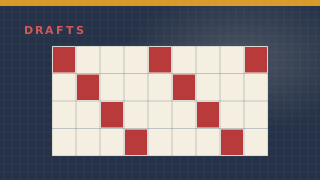
A weave draft is a diagram of a cloth, drawn on squared paper. It has four parts, and once you can read them you can weave anything anyone has ever written down.
The four parts
Threading
The top grid. Read left to right, one column per warp end, showing which shaft that end is threaded on. This is what you do at the loom with the heddle hook.
Tie-up
The grid at the right. One row per shaft, one column per treadle, showing which shafts each treadle lifts. This is what you do with the tie-up cords, once.
Treadling
The grid below the tie-up. Read top to bottom, one row per pick, showing which treadle to press. This is what you do with your feet while weaving.
Drawdown
The large grid in the middle. The cloth as it will look from above, derived from the other three. You do not weave this; you read it to check the pattern.
The convention that trips everyone
A filled square in a drawdown means the warp is on top. Some books invert this. If a draft looks inside-out, check which convention the book uses before you assume you have made a mistake.
Reading a draft from a book
Start at the threading. Count the columns to get the number of ends in the repeat, then count how many times the repeat must be repeated to fill your width. If the total is not a whole number of repeats, add a balancing end or two at each selvedge so the pattern is symmetrical.
Then count the shafts. If the draft needs more shafts than your loom has, you cannot weave it — but check first, because many drafts are written for eight shafts and have a four-shaft simplification printed alongside.
Then read the tie-up and the treadling together to work out the pick sequence. Write the sequence out as a list of treadle numbers, and count how many picks are in the repeat.
Write it out by hand
Copy the draft into your own notebook in your own handwriting. You will remember the structure, and you will catch the errors that a photocopy would have hidden.
Designing your own
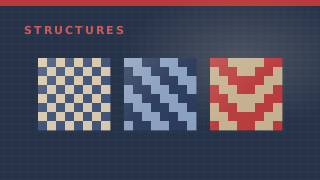
Designing is easier in the other direction. Decide what you want the cloth to look like, then work backwards to the threading. A diagonal means a step of one end per pick. A diamond means a step that reverses. A block pattern means groups of ends threaded together on the same shaft.
- To move the diagonal one way, thread straight: 1, 2, 3, 4.
- To move it the other way, thread point: 1, 2, 3, 4, 3, 2.
- To make blocks, thread runs of ends on the same shaft.
- To make lace, leave gaps between threaded ends and let the floats bridge them.
The drawdown will tell you immediately whether it worked. That is the great advantage of the grid: it costs nothing to draw a bad cloth and cross it out.
Where to start
Begin with a four-shaft straight twill, then a point twill, then herringbone. Those three drafts contain the whole grammar: step, reverse, and break. Everything else is variation.
Draw each one by hand, weave it in a wool you like, and put the swatch and the draft in a notebook together. That notebook will teach you more than any book, because it is about your yarn and your loom.