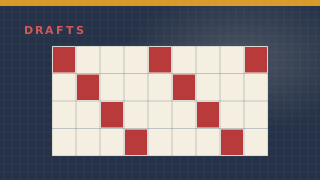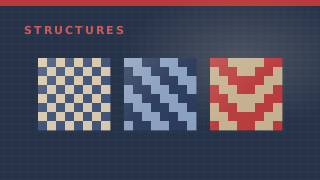
A weave structure is simply a rule for how often each warp end goes over or under the weft. Change the rule and you change the cloth: its surface, its drape, its strength and its name.
Plain weave
Every end goes over one pick and under the next; every pick goes over one end and under the next. It is the tightest possible interlacement, which makes it the most stable and the most abrasion-resistant cloth you can weave. It is also the least interesting to look at, which is why it is the base for colour-and-weave effects rather than pattern.
Plain weave needs the fewest shafts — two, or one rigid heddle — and it is the structure to use when the cloth has to work: towels, aprons, upholstery grounds, anything washed hard.
Twill
In a twill, the interlacement steps sideways by one or more ends on each successive pick, producing a diagonal line. Because the ends float over two or more picks, a twill is softer, drapier and less abrasion-resistant than plain weave of the same sett — but it can be set more densely, which gives a heavier, warmer cloth.
The classic is a 2/2 twill: each end goes over two picks and under two. Reverse the direction every few ends and you have herringbone. Break the diagonal at regular intervals and you have a diamond. Twill is the structure behind denim, suiting and almost every wool coating.
Float length is the number to watch
A float is how many picks or ends a thread passes over without interlacing. Floats under about 5 mm are strong; longer floats snag, pill and wear through. The Pattern Designer reports the longest float in your draft.
Satin
A satin takes the float as far as it will go: each end passes over four, seven or more picks before interlacing once. The result is a surface that is almost entirely warp (warp-faced satin) or almost entirely weft (sateen), which is why it reflects light as a smooth, lustrous sheet with no visible diagonal.
Satin is the most demanding structure to weave well, because the long floats show every fault and snag on everything. It is also the most beautiful when it is right, and it needs a minimum of five shafts — seven or eight for the classic versions.
| Structure | Interlacement | Shafts | Character | Best for |
|---|---|---|---|---|
| Plain | 1 up, 1 down | 2 | Firm, stable, matte | Towels, aprons, upholstery |
| Twill | Step of 1–2, float 2–4 | 3–4 | Soft, draping, diagonal | Coating, denim, suiting |
| Herringbone | Twill reversing | 4 | Diagonal that zigzags | Suiting, blankets |
| Satin | Float 4+ | 5–8 | Lustrous, smooth, fragile | Lining, damask, evening wear |
| Lace / huck | Floats + plain ground | 4–8 | Textured, open, absorbent | Hand towels, table linen |
| Tapestry | Weft-faced, hand-picked | 0 | Pictorial, dense, heavy | Wall hangings, rugs |
Choosing between them
- If the cloth must wear well, choose plain weave and a firm sett.
- If you want drape and warmth, choose a twill and set it densely.
- If you want surface and light, choose a satin and accept the fragility.
- If you want texture that also absorbs, choose a lace or huck draft.
- If you want a picture, you are in tapestry territory and the loom is almost incidental.
Every one of these structures is a draft — a threading, a tie-up and a treadling. The next article covers how to read one.