Weaving Tools
Fringe twister
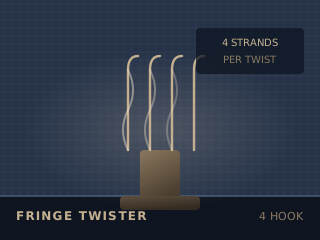
Twists the fringe evenly, four strands at a time
Lock the brake firstNever cut a tensioned warpMask up for dusty fibreVentilate the dye areaTie back hair · check heddles · ventilate
Specifications
| Hooks | 2 or 4 |
|---|---|
| Length | 12 – 20 cm |
| Materials | Wood and brass, or plastic |
| Crank | Side crank, geared |
| Grip | Locking clamp |
| Speed | Very high |
Technical parameters
| Strands per twist | 2 – 8 warp ends |
|---|---|
| Twist direction | Set by turning the crank |
| Finish | Knot after twisting |
| Best for | Scarves, shawls, rugs |
| Maintenance | Keep the hooks clean |
4Finish4 – 24 dpi
Overview
A fringe twister is a small hand tool with two or four hooks that twists groups of warp ends together in one motion. It turns the loose end of a warp into a neat, secure, even fringe in a fraction of the time hand-twisting takes — and far more uniformly.
Typical figure for this stage: 30 – 60 °C. Wet-finish, full or press the cloth so the fibres relax and the weave settles.
Safety notes
The hooks are sharp and under tension during twisting. Keep fingers out of the hook line and pull steadily rather than jerking. Repetitive twisting strains the wrist — take breaks, and alternate hands where you can.
Using it well
- Divide the fringe into even groups before you start; the eye reads even groups as a tidy fringe.
- Twist tighter than you think you need — the twist relaxes when you release it.
- Knot the end immediately after twisting so it cannot unravel.
- Trim the fringe after washing, when the yarn has bloomed and the length is final.
Works with
Practise it in 3D
Run this stage as an interactive simulation, with the same figures this page quotes.
Open the simulatorEducational reference. Specifications are typical published ranges for this class of equipment or material, not a specification for any one product. Always follow the manufacturer’s instructions and local rules. Nothing here is a guarantee of cloth, colour or result.