Weaving Tools
Heddle
Holds one warp end and lifts it
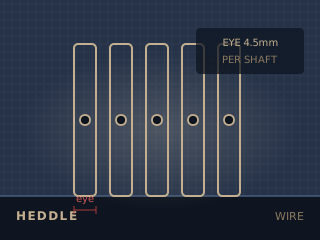
Specifications
| Type | Wire, string, inserted, rigid |
|---|---|
| Eye size | Depends on yarn count |
| Quantity | 4 – 24 per shaft, 100+ per loom |
| Materials | Stainless steel, cotton string, plastic |
| Compatibility | Match shaft frame |
| Spacing | Even along the shaft |
Technical parameters
| Threading | Straight, point, skip, block |
|---|---|
| Count needed | Total warp ends |
| Care | Keep dry, free of rust |
| Best for | Every multi-shaft loom |
| Order | Front to back or back to front |
Overview
Each heddle holds a single warp end and is carried by a shaft, so lifting the shaft lifts exactly those ends. The pattern of which end sits in which heddle — the threading — is half of the draft. Wire, string and inserted heddles each suit different fibre and count.
Typical figure for this stage: 4 – 16 shafts. Lift the right shafts in the right order. The draft is the pattern; the loom just follows it.
Safety notes
A heddle hook is a fine steel point: always draw it toward your body at an angle, never toward your other hand, and never toward your face. Wire heddles have sharp cut ends — check the frame for protruding wire before threading. Work at a height that keeps your wrists straight.
Using it well
- Count your heddles before you start: running out mid-threading is miserable.
- Thread back to front if you have a helper; front to back if you are working alone and the cross is clean.
- A heddle hook makes threading twice as fast and much kinder on your hands.
- Check for rust and burrs — a damaged eye will fray the warp end running through it.
Works with
Practise it in 3D
Run this stage as an interactive simulation, with the same figures this page quotes.
Open the simulator