Dyeing & Finishing
Indigo dye
The vat that dyes blue by oxidation
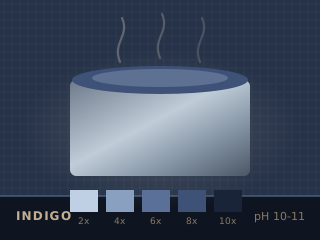
Specifications
| Type | Natural (plant) or synthetic |
|---|---|
| Vat pH | 10 – 11 (alkaline) |
| Reducing agent | Thiourea dioxide, fructose or natural fermentation |
| Dips for depth | 3 – 12 |
| Lightfastness | Excellent (7 – 8 of 8) |
| Washfastness | Good after rinsing |
Technical parameters
| Stock concentration | 1 – 3 g/L synthetic |
|---|---|
| Vat temperature | 20 – 50 °C |
| Dip time | 1 – 5 minutes |
| Air time | 10 – 20 minutes between dips |
| Colour range | Pale sky to near-black blue |
Overview
Indigo is not like other dyes: it is insoluble in water, so it is chemically reduced into a yellow-green vat, the fibre is dipped, and the blue only appears when the fibre meets the air. Colour builds in layers, one dip at a time, which is why indigo cloth has such depth.
Typical figure for this stage: 30 – 60 °C. Wet-finish, full or press the cloth so the fibres relax and the weave settles.
Safety notes
Indigo vats are strongly alkaline and can cause serious eye damage — wear goggles and gloves, and never work at eye level over an open vat. Lye and reducing agents are caustic and react with acids: add them slowly, never to hot liquid, and never mix with other chemicals. Work outdoors or with strong ventilation; the reduced vat gives off a pungent odour and fermentation vats produce gas. Keep all dye chemicals locked away from children and animals, labelled, and never in a food container.
Using it well
- The vat should look like a dark mirror with a coppery skin. If it is blue and cloudy, it is oxidised and needs reducing.
- Never let the fibre touch the vat sediment — it holds unreduced dye that rubs off as crocking.
- Colour builds slowly. Six short dips give a better blue than two long ones.
- Rinse thoroughly and dry in shade; indigo crocks onto everything until it is fully rinsed.
Practise it in 3D
Run this stage as an interactive simulation, with the same figures this page quotes.
Open the simulator