Fibers & Yarns
Linen yarn
Stiff, lustrous and stronger wet
Specifications
| Count | 6 – 40 Nm (lea) |
|---|---|
| Staple length | 20 – 60 cm |
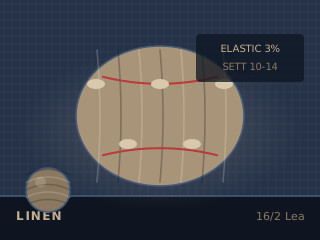
| Elasticity | Very low — 2 – 4 % at break |
| Sett (plain weave) | 10 – 14 EPI |
| Shrinkage | 8 – 15 % |
| Dye affinity | Moderate, needs a mordant |
Technical parameters
| Fiber diameter | 12 – 25 µm |
|---|---|
| Strength (dry / wet) | High / higher |
| Handling | Stiff, cold, wiry |
| Best weaves | Plain, huckaback, damask |
| Care | Machine wash warm, press damp |
Overview
Linen is made from flax fibre and behaves like nothing else: stiff and wiry on the cone, it softens with every wash and ends up supple and cool with a characteristic sheen. It has almost no elasticity, so it shows every irregularity — but nothing else feels like it.
Typical figure for this stage: 8 – 20 N tension. Measure, wind, thread and tension the warp. Most weaving problems are warp problems.
Safety notes
Flax fibre is dusty and the dust is a known respiratory irritant — ventilate and mask up when winding, and never dry-sweep. Sharp kinks in stiff linen can cut; handle wet linen carefully. Linen creases hard, so pressing needs heat and moisture — mind your hands on the iron.
Using it well
- Linen yarn has slubs and thick places by nature — do not try to weave it perfectly uniform, it is not that fibre.
- Wind it under lower tension than cotton; it has no stretch to absorb a mistake.
- Wet-finish linen aggressively. It is harsh on the loom and beautiful after three washes.
- Linen damask and huckaback show the fibre at its best.
Practise it in 3D
Run this stage as an interactive simulation, with the same figures this page quotes.
Open the simulator