Patterns & Drafts
Pattern book
A library of drafts, tied up and ready
Specifications
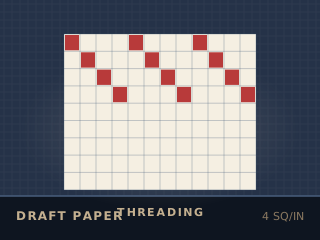
| Content | Threading, tie-up, treadling, drawdown |
|---|---|
| Typical size | 100 – 400 drafts |
| Shafts covered | 4, 8 and sometimes 16 |
| Format | Print, spiral or PDF |
| Reference works | Davison, Oelsner, Swedish collections |
| Level | Beginner to advanced |
Technical parameters
| Organisation | By shaft count and weave family |
|---|---|
| Weave families | Twill, overshot, lace, summer and winter, crackle |
| Best for | Finding a repeatable pattern |
| Use with | Draft paper, sample notebook |
| Note | Always sample a new draft |
Overview
A pattern book collects drafts — threading, tie-up and treadling — that are known to work. Oelsner, Davison and the classic Swedish collections are the standard references; a good book turns "I wonder what that would look like" into a warp you can put on tomorrow.
Typical figure for this stage: 4 – 16 shafts. Lift the right shafts in the right order. The draft is the pattern; the loom just follows it.
Safety notes
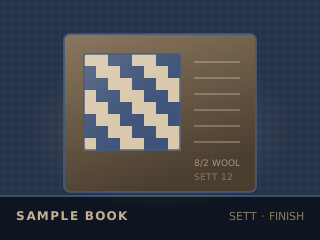
A reference book is a reference, not a guarantee. A draft that worked in 8/2 cotton may be sleazy in a wool of the same count, because the fibres behave differently. Sample, and write down what you actually did.
Using it well
- Pick a book that matches your shaft count; a 16-shaft book is useless on a 4-shaft loom.
- Sample before you commit a long warp — the same draft looks different in a different yarn.
- Copy the draft into your own notebook in your own hand. You will remember it that way.
- Weave families repeat across cultures; learn one properly and the others get easier.
Practise it in 3D
Run this stage as an interactive simulation, with the same figures this page quotes.
Open the simulatorRelated